
Spain Digital Nomad Visa 2026: Requirements, Income, Steps
Spain digital nomad visa guide for 2026: requirements, minimum income, Social Security, how to apply from abroad or Spain, family rules and fees.
Document review included · until November 30
Applying for the digital nomad visa?
We advise you and help with your case.
On a video call, a lawyer looks at your case, tells you what you need to do and how to apply with confidence. If we then handle the application for you, the consultation is free.

Constanza Rossi Vibbot
Licensed lawyer ICAB no. 49.586 · Immigration
Online service · All of Spain and abroad
Since Law 14/2013, known as the Entrepreneurs Law, was approved, Spain has developed a specific legal framework for attracting international talent. This framework regulates the authorisation for international remote workers, a process managed by the Large Companies and Strategic Groups Unit (Unidad de Grandes Empresas y Colectivos Estratégicos, UGE-CE).
What is Spain's digital nomad visa?
Spain's digital nomad visa (visado para teletrabajo de carácter internacional) is a residence authorisation aimed exclusively at citizens of countries outside the European Union, European Economic Area and Switzerland. Its purpose is to allow them to live legally in Spain while carrying out remote employment or professional activity for companies established outside Spain. The defining feature is that the work is carried out entirely using IT, telematic and telecommunications systems.
This authorisation differs from other permits, such as non-lucrative residence (residencia no lucrativa), because it does allow economic activity, provided that activity is for entities abroad. It removes the need for an employment contract with a Spanish company, which is the usual requirement for other work authorisations. Applications filed from Spain are handled by the UGE-CE, reflecting the focus on qualified professionals and their contribution to the economy. The international teleworking procedure is designed to be fast and fully digital.
Employee vs self-employed digital nomad applicants
 Digital nomad visa applicant profiles.
The rules distinguish between two professional profiles that can qualify for this authorisation, each with specific requirements showing a pre-existing and stable professional relationship.
Employees
Applicants who work for a company as employees must prove an employment relationship of at least three months with that foreign company. The company must also have been operating for at least one year. The employee must have express authorisation from the employer to work remotely from Spain. This type of permit falls within what the Spanish system defines as an autorización por cuenta ajena (in Spanish), with the particular feature that the employer is foreign.
Self-employed professionals
Self-employed professionals or freelancers must show a commercial relationship with one or more client companies abroad, also lasting at least three months. As in the employee route, the company or main client must have at least one year of activity. For a self-employed digital nomad, Spain offers the possibility of establishing a base of operations within a legally secure framework. In both profiles, the applicant must prove a professional qualification, either through a university or postgraduate degree or by showing at least three years of professional experience in comparable functions.
Social Security requirement for Spain's digital nomad visa
Registration (alta) in the Spanish Social Security system is an essential requirement for maintaining the authorisation. The rules are explicit on this point: failure to register, or stopping contributions, leads to automatic termination of the residence authorisation for both the main holder and dependent family members. The administration checks this requirement directly.
There are two ways to comply, depending on the professional relationship:
1. Employees: the foreign company must register with Spanish Social Security. Registering lets the company enrol the employee in the general social security scheme (Régimen General) and creates no permanent establishment.
2. Self-employed professionals: the professional must register in the Special Scheme for Self-Employed Workers (Régimen Especial de Trabajadores Autónomos, RETA). This can be simplified by arranging registration through an Entrepreneur Service Point (Punto de Atención al Emprendimiento, PAE), which centralises formalities with the tax authorities (Hacienda) and Social Security.
Although Spain has bilateral Social Security agreements with some countries, the UGE's guidance is that registration in Spain is the general rule. Planning Spanish Social Security registration is therefore a critical step from the start of the process.
Spain digital nomad visa requirements and income requirement
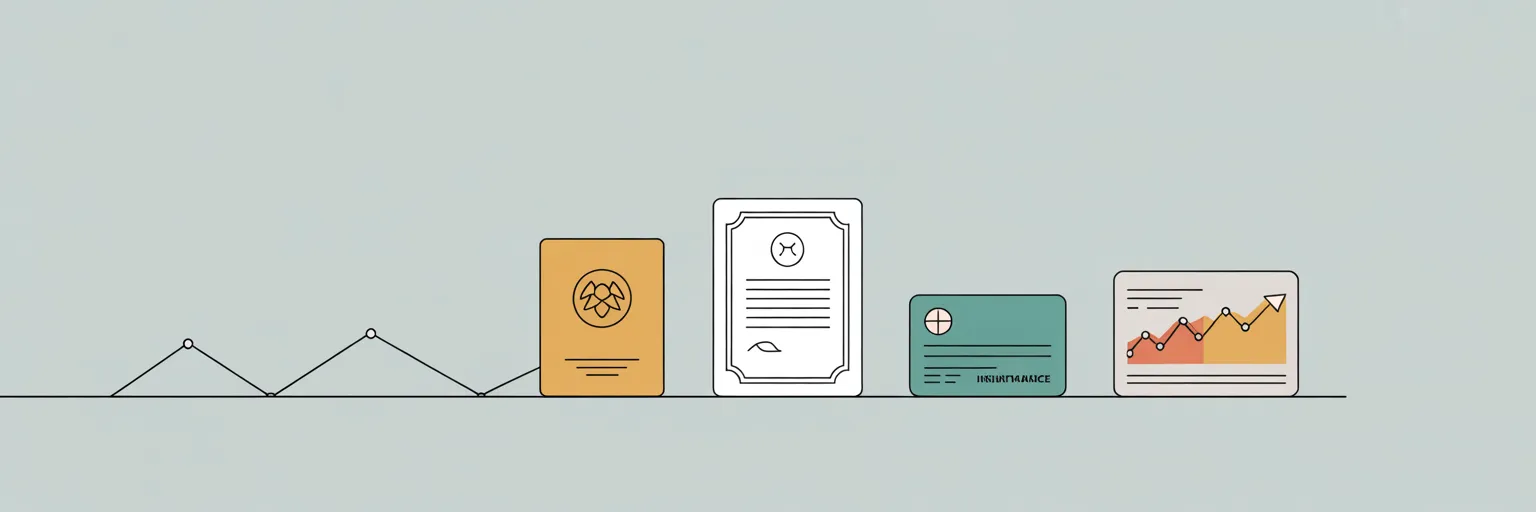 Key requirements for the international remote-work visa.
In addition to proving the employment or professional relationship, applicants must meet a series of general conditions. Meeting all the Spain digital nomad visa requirements is essential for the application to be admitted for processing (admitida a trámite) and decided favourably. An application filed from Spain is submitted online and requires a digital certificate (in Spanish).
The main requirements are:
1. Personal situation: you must be an adult and must not be in an irregular immigration situation (situación irregular) in Spain.
2. Criminal record: you must provide a criminal-record certificate from the country or countries where you have lived during the previous two years. In addition, you must provide a sworn statement (declaración responsable) stating that you have no criminal record during the previous five years.
3. Health insurance: you must have public or private health insurance contracted with an insurer authorised to operate in Spain. It must provide full cover equivalent to the Spanish National Health System, with no co-payments or waiting periods. Travel insurance is not valid for this purpose.
4. Financial means (medios económicos): you must prove sufficient financial resources for yourself and your family members. For 2026, the minimum amounts are based on the 2026 Spanish minimum wage (Salario Mínimo Interprofesional, SMI), set at €1,221 per month:
- Main applicant: 200% of the SMI, equal to €2,442 per month.
- Second family member: an additional 75% of the SMI, or €915.75.
- Each additional family member: an additional 25% of the SMI, or €305.25 per person.
Minimum financial resources for 2026, based on an SMI of €1,221:
| Family-unit member | Required percentage of SMI | Minimum monthly amount |
|---|---|---|
| Main applicant | 200% | €2,442 |
| Second member, family unit of 2 | +75% (total 275%) | €3,357.75 total for 2 people |
| Each additional member | +25% | +€305.25 per person |
Note: these calculations are based on the 2026 SMI of €1,221 per month. The exact amount will depend on the SMI in force when you apply.
Can I combine the digital nomad visa with other statuses?
It is important to understand how this authorisation interacts with other immigration statuses. The international teleworking authorisation (autorización de residencia para teletrabajo de carácter internacional) is incompatible with non-lucrative residence, because the latter expressly prohibits any employment or professional activity.
It can, however, be compatible with a higher-education student stay under one very specific condition. A student can change status to an international teleworking authorisation if, during their legal stay as a student, they were already working for the foreign company and registered with Spanish Social Security under the rules that allow study and work to be combined. For more information on that previous status, see the student visa entry (in Spanish).
One advantage of Law 14/2013 is its flexibility. A holder of an international teleworking authorisation can change to another authorisation under the same law, such as the highly qualified professional authorisation, at any time, provided they meet the specific requirements for the new authorisation.
Which permit do you want to apply for? Tell the lawyer about your case
The lawyer reads your case and tells you how to proceed: a consultation to review it with your documents, or we handle the whole application for you.
Want to know what to do right away?
On a video call the lawyer reviews your documents and gives you a plan for your case.
Book your consultationCan I work for Spanish companies? The 20% rule
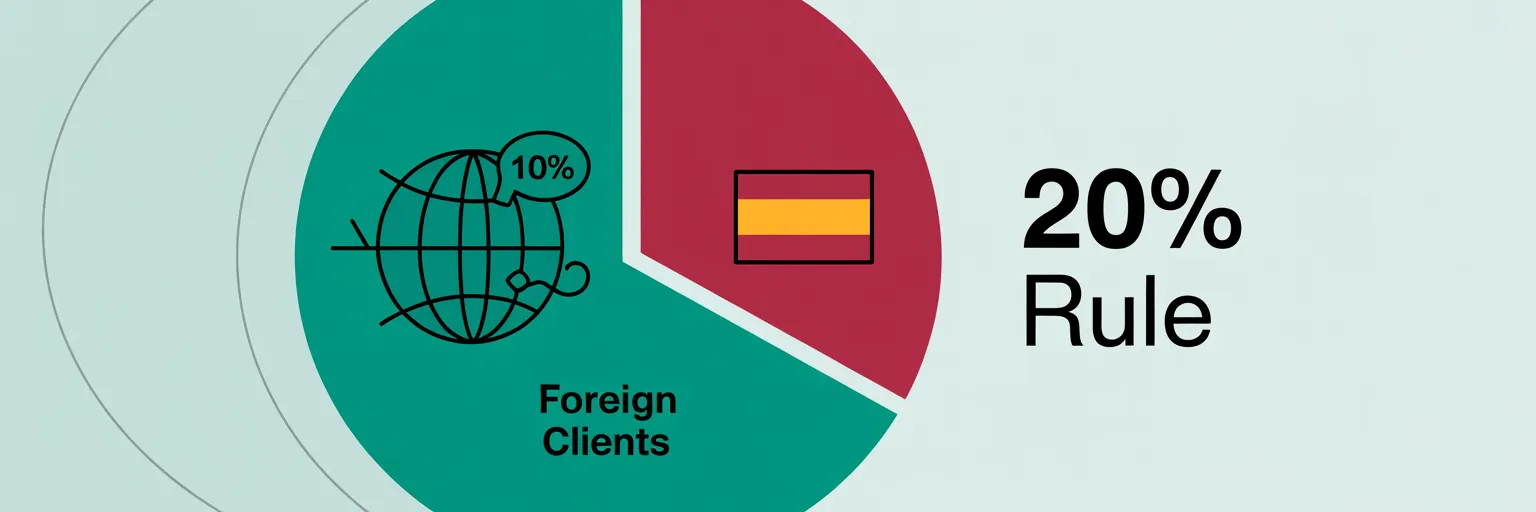 The 20% rule for work in Spain.
The rules provide controlled flexibility for self-employed professionals. A self-employed person with this authorisation may provide services to companies located in Spain, but there is a clear limit: income from Spanish clients cannot exceed 20% of total professional turnover.
This possibility is limited to a commercial or professional relationship, meaning that the person invoices as self-employed. An employment contract with a Spanish company is not permitted. This rule reinforces the main purpose of Spain's international teleworking residence authorisation: enabling people whose main economic activity is with foreign entities to live in Spain while allowing only limited participation in the local market.
How to apply for Spain's digital nomad visa
The route to residence as an international remote worker differs significantly depending on whether the application starts in the country of residence or directly in Spain.
Apply from abroad: one-year visa
If you are outside Spain, you must apply for an international teleworking visa at the Spanish consulate in your country of residence. This visa is valid for a maximum of one year and allows you to enter and live in Spain while working remotely. During the 60 calendar days before the visa expires, you can apply to move to a three-year residence authorisation.
Apply from Spain: three-year residence authorisation
If you are already legally in Spain, for example as a tourist or holder of another stay authorisation, you can apply directly for a three-year international teleworking residence authorisation. The application is submitted online to the UGE. The permit can be renewed for periods of two years, provided the original conditions continue to be met. The UGE provides the required documentation on its official portal; you can check the official UGE document list.
Can I bring my family on Spain's digital nomad visa?
 Family members and their right to work in Spain.
The law allows the main international remote worker to be accompanied by direct family members. Eligible family members include a spouse or registered partner (pareja de hecho registrada), minor children or adult children who are financially dependent on the main applicant, and dependent ascendants. Family applications can be submitted together with the main application or at any later time.
The most significant benefit for family members, established in the fourth additional provision (Disposición adicional cuarta) of Law 14/2013, is that they receive an authorisation to live and work in Spain without restriction. They can therefore be employed by a company or become self-employed under the same conditions as a Spanish citizen. This right makes the position of a family member under this route (in Spanish) one of the most advantageous in the system. To include family members, the main applicant must of course show sufficient financial means for the whole family unit, using the amounts set out above.
Spain digital nomad visa fees in 2026
Applying for the residence authorisation requires payment of an administrative fee (tasa). For 2026, the fee under modelo 790 (código 038) is €73.26 for each applicant, including the main applicant and each family member applying with them. Consular fees for a visa application from abroad may vary.
The fee must be paid before the application is submitted, and proof of payment is a mandatory document that must be attached to the application. The administration allows payment online by:
- Credit or debit card.
- Direct debit from a bank account.
- Bizum.
This fee system is used in many immigration procedures, as can be seen in other processes using similar forms such as modelo 790 012 (in Spanish).
Want to review your case before preparing this process?
If your case is complex or you want to reduce the risk of mistakes, we review the documents, route fit, and next steps before filing.